Cobbles, standing and access

What the walk asks of you
An hour and a half outdoors, covering roughly a kilometre between Nytorv and Kongens Nytorv. The distance is small; the standing is not. A guided walk of this kind stops repeatedly — on a square, at the mouth of a street, in front of the court house — and each stop is several minutes on your feet without anywhere to sit. If standing still for ten minutes at a time is the difficulty rather than walking, that is the thing to weigh.
The surface is the other consideration. The old city is cobbled: the squares, the older streets, and the stretches around Strøget, which was pedestrianised in 1962 and runs through Gammeltorv and Nytorv. Cobbles are uneven by construction, and they are worse wet and in the dark, which in late October means from half past four onwards.
What this site will not tell you
Whether the route is navigable in a wheelchair, whether there are kerbs without drops, whether a particular stop can be reached another way. Nobody has published that and guessing at it would be worse than useless, because somebody would plan an evening around the guess. The operator runs the walk, knows the route and can answer for it. Contact them through the booking platform before you book; the listing on the widget below is the route to them.
The same applies to the two Danish-language walks, which are run by the same operator and are similar in shape: 75 minutes from Højbro Plads, 90 minutes from the University steps, both on foot and both outdoors.
What works
- The distance is short: about a kilometre in ninety minutes
- The route stays in the flat centre of a flat city
- The self-guided hunts let you set your own pace and stop whenever
- The giants walk carries private transport between its stops
- Free cancellation on the ghost walk up to a day before
Worth knowing
- Cobbled squares and streets for most of the route
- No seating anywhere on the guided route
- Long stationary stops, which is harder than walking for some people
- It runs in rain and cold, so the surface may be wet
- No published step-free information — ask the operator
The self-guided hunts are the most adaptable thing on this site and nobody says so. You choose the hour, the pace and the breaks; you can sit down in a café halfway through the case and nobody is waiting; and the Amalienborg one stays valid for 93 days, so an afternoon that turns out to be too much can simply be finished another day.
The alternatives, by what they demand
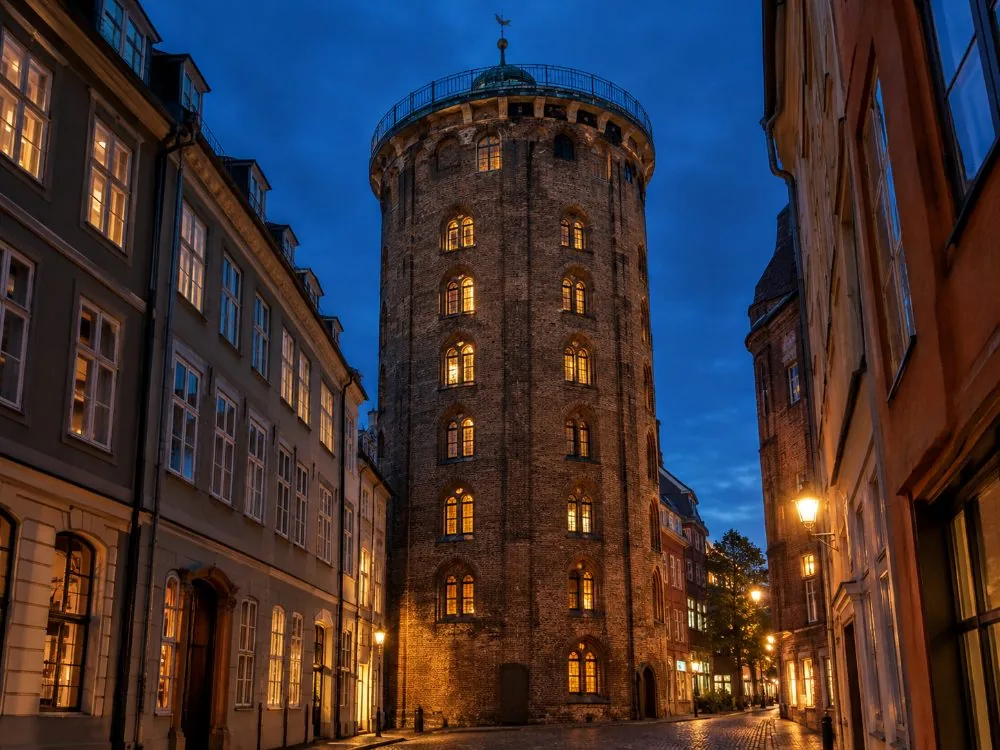
The self-guided hunts. Analogue, paper and a pen, no phone needed. The routes are central — Rundetårn to Gammeltorv, or the pier to Nyhavn — and the pace is yours entirely. A party of at least two, and two to four suits them best. See the Round Tower hunt.
The six giants. Four hours with private transport between the trolls, which removes the city walking but adds a long day and its own terrain out of town, and children under twelve are not admitted. Ask the operator what the ground is like if that matters: the giants page.
Assistens Cemetery. Not a tour at all. Twenty-five hectares of park in Nørrebro, opened in 1760, with paths and benches and Hans Christian Andersen buried in it, and you go at your own speed on your own afternoon: the cemetery page.
Practical points worth raising with the operator
Group size and how far the guide walks between stops. Whether you can join partway or leave early without disrupting the group. Whether a folding stool would be in anybody’s way. Whether any part of the route avoids the worst of the cobbles. These are the questions a small operator can answer and a website cannot. The walk is not cancelled for weather, so also ask what happens on a night when the stone is wet: what to wear.
And check the month. An October evening is dark and mild; a January one averages 1.4 °C with cold waves to fifteen below, which changes what ninety minutes of standing asks of anybody. The best month page.
 A killing in 1899
Copenhagen: Murder Mystery Hunt by The Round Tower
 Nineteenth-century murder
Copenhagen: Murder Mystery Hunt by Amalienborg Palace
 Six trolls in the woods
Copenhagen: The Six Forgotten Giants Hunt and Nature Walk
Frequently asked questions
Is the Copenhagen ghost walk wheelchair accessible?
There is no published step-free information for the route and this site will not invent any. It is an hour and a half on foot over central streets and squares, largely cobbled. Ask the operator through the booking platform before you book.
How much standing is involved?
A good deal. The walk covers about a kilometre in ninety minutes, so most of the time is spent stationary at stops: how long it takes.
Are there seats on the route?
No. There is nowhere to sit on the guided route. The self-guided hunts let you stop in a café whenever you like: guided against self-guided.
Does the walk go ahead in bad weather?
Yes, it runs in rain and cold rather than being cancelled, which means the cobbles may be wet: what to wear.
Which option is easiest to adapt?
A self-guided hunt. You choose the hour and the pace, and the Amalienborg case stays valid for 93 days: the Amalienborg hunt.