The Round Tower murder mystery
What the hunt is
You are handed a case from 1899 and turned loose on the old city with it. The story gives you detective constables, a person who has gone missing and a briefcase with blood on it; the route gives you seven places to stand while you work out what the papers in your hand mean. Nothing runs on a screen. There is no timer, no guide waiting at the corner and nobody to tell you that you have gone wrong, which is either the appeal or the objection depending on who you are travelling with.
Mats, from Sweden, wrote of the companion hunt at Amalienborg that the good part was “that it was actually a bit difficult to solve”. Take that as the warning and the recommendation together. A traveller from Italy left one word for this one on 17 August 2026: “Beautiful.” Two reviews is not a sample, and you should read the score that way. The review page says so at more length.
The route, and what is actually there
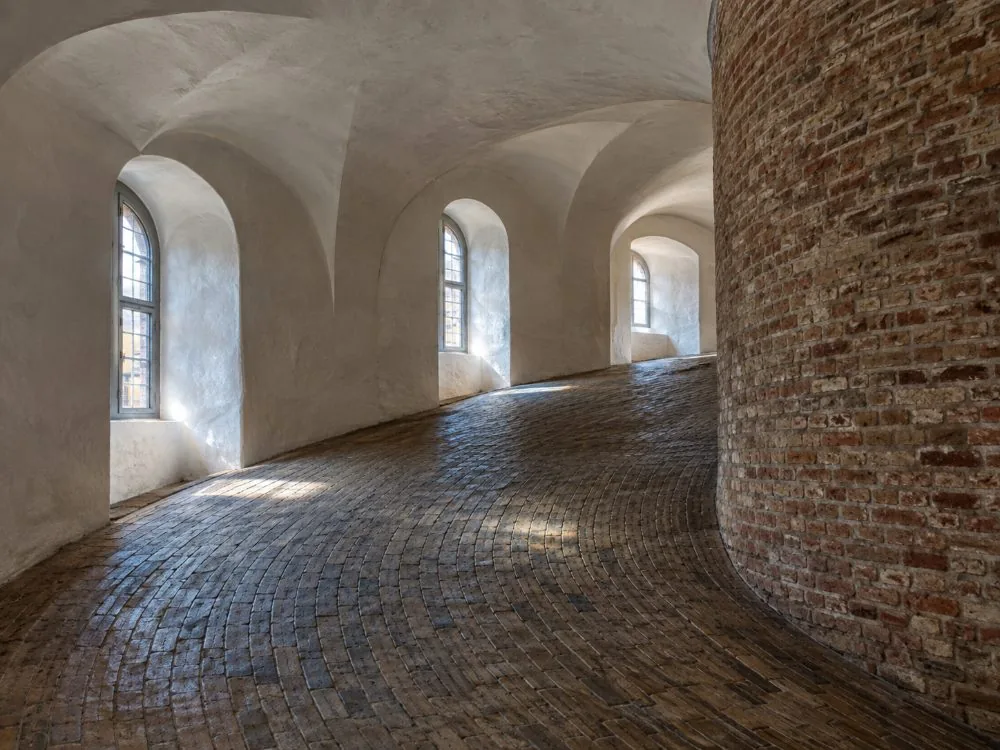
Rundetårn was completed in 1642 for Christian IV. Inside it a spiral ramp of seven and a half turns climbs 34.8 m above street level, built wide enough for a horse and carriage to reach the library at the top; in 1716 Tsar Peter the Great rode up it on horseback, his wife reportedly following in a carriage. The observatory at the top worked until 1860. The fire of October 1728 destroyed 35,000 volumes of the University library held there, along with instruments and records of Tycho Brahe and Ole Rømer. More on the tower.
Vor Frue Kirke, the Church of Our Lady, is on the route because the British burned it. In September 1807 British gunners used its tower for range practice, set it alight and burned the cathedral to the ground during a three-day bombardment that fired 300 Congreve rockets into the city and killed about 195 civilians. C.F. Hansen rebuilt it: cornerstone in 1817, consecrated on 7 June 1829. The bombardment.
Gammeltorv holds the Caritas Well, put up by Christian IV in 1608. The town halls that stood on this square burned in 1728 and again in 1795, after which the function moved across to Nytorv, where the guided ghost walk now assembles. Strøget was pedestrianised in 1962 at 1.1 km, then the longest pedestrian street in Europe, and it runs straight through Gammeltorv and Nytorv. More on Strøget.
How it works in practice
Two people is the floor and four is about the ceiling of usefulness: past that, somebody is walking behind the group holding nothing. The analogue format is the thing that makes this work with a mixed party — nobody is looking at a phone, and a puzzle on paper can be passed around a table in a café when it rains. Copenhagen’s centre is flat and short-distance, which is what makes a walking puzzle reasonable here at all. How walkable the city is.
Included
- A self-guided murder-mystery case set in 1899
- A fixed route through seven places in the old city
- Material you work through on paper, in English or Danish
- The freedom to start whenever you like and stop for lunch
- A format that works with no app and no phone
Not included
- Food and drink
- Public transport tickets
- Entry fees to any building on the route, including the tower itself
- A guide, or anyone to tell you the answer — that is the guided walk
- A pen, if you turn up without one
- Anything for a solo traveller: the minimum is two people
What works
- It starts when you want it to, which no guided walk here does
- Analogue by design: no app, no battery, no signal problem
- It works in English or Danish, unlike the two guided Danish walks
- The route covers the old city properly rather than one square
- Two to four people is a real recommendation and a good size for a puzzle
- Rain is an interruption rather than a cancellation — you set the pace
Worth knowing
- Two reviews. The 4.5 is close to meaningless as a statistic
- Minimum two people, so a solo traveller cannot book it
- It is a puzzle, not a ghost story: the scares are not the point
- Nobody is there to unstick you if the group gets stuck
- Entry fees, food and transport are all on you
- A party larger than four will have passengers
Do this one in daylight and save the evening for the guided walk. The route runs through Strøget and Gammeltorv, which are busy shopping streets rather than atmospheric alleys, and reading paper puzzles in the dark in October is a worse experience than it sounds. The city’s darkness is an asset for the lantern walk and an obstacle here.
Book the hunt
Live availability is below. The companion case at Amalienborg runs the same format on the harbour side of the city and stays valid for 93 days, and guided or self-guided sets out which of the two formats suits which sort of group.
If this one is not right
 Nineteenth-century murder
Copenhagen: Murder Mystery Hunt by Amalienborg Palace
 Lantern and black cloak
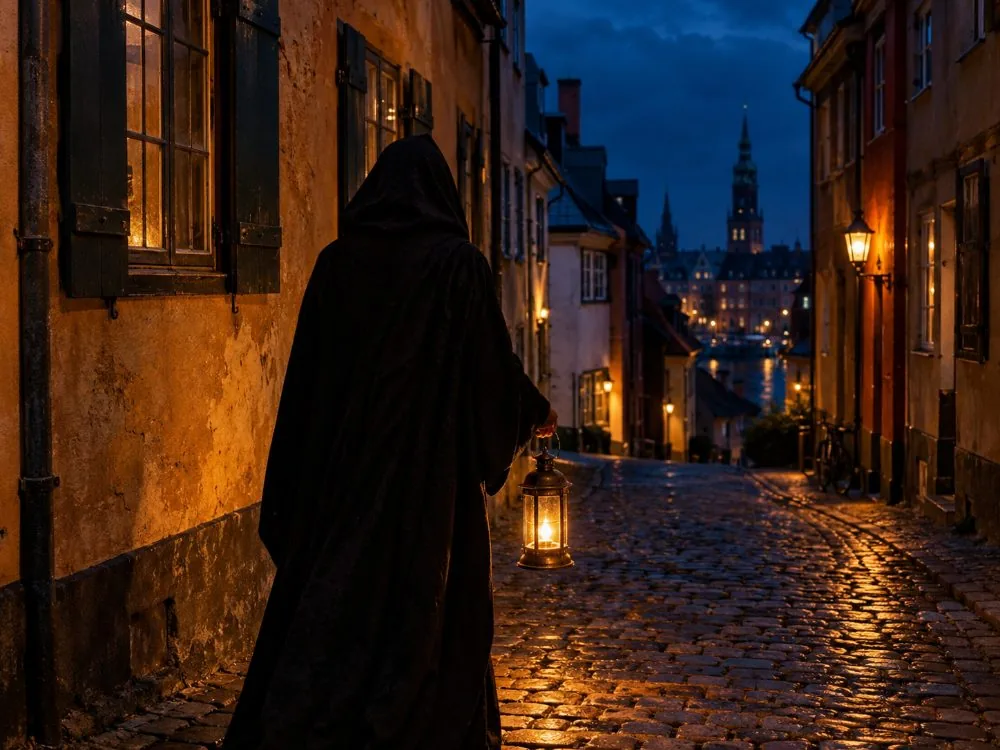
Copenhagen: Guided Ghost Walk through Haunted City
 Six trolls in the woods
Copenhagen: The Six Forgotten Giants Hunt and Nature Walk
Those dates don’t work?
The guided ghost walk runs on set evenings and sells out early in October. Browse what else is bookable in Copenhagen — the self-guided murder mysteries you can start whenever you like, and the daytime walks — and pick a date that suits you, with instant confirmation.
Frequently asked questions
Do I need a phone or an app for this hunt?
No. It is fully analogue — the material is on paper and you need a pen. That is unusual among self-guided products and it is the best thing about this one: guided versus self-guided.
Can one person do it alone?
No. The minimum party is two, and two to four is the recommended size. A solo traveller wants the guided ghost walk instead.
Where does the route go?
Rundetårn, Gråbrødretorv, Købmagergade, Strøget, Vor Frue Kirke, Gammeltorv and Vor Frue Plads. All of it is central and flat: walking in Copenhagen.
Is it hard?
A reviewer of the companion hunt at Amalienborg praised it for being “actually a bit difficult to solve”. Nobody is there to help, so bring someone who likes crosswords.
Does the ticket include going up the Round Tower?
No. Entry fees are not included, and neither is food, drink or transport. What shapes what you pay is on the cost page.